Showing posts with label Google. Show all posts

Google Adds Complete Content Of United States Constitution To Search Results

Written By Unknown on Thursday, 17 September 2015 | 21:38


google-legal1-white-ss-1920

Google Adds Complete Content Of United States Constitution To Search Results

To celebrate Constitution Day and further the efforts of The Constitution Project, Google has added constitutions from 13 countries.

Amy Gesenhues on September 17, 2015 at 3:13 pm

Just in time for election season, Google is making it easier for we the people — and our political candidates — to quickly reference the complete text of the United States Constitution.
21:38 | 0 comments | Read More

Search Engine Journal: Google Adds Pinterest, Vine, and More To New Mobile Search Carousel

Written By Unknown on Tuesday, 30 June 2015 | 02:57


shutterstock_237551212

Search Engine Journal: Google Adds Pinterest, Vine, and More To New Mobile Search Carousel

Google announced an addition to its mobile search results that will give people quick access to what the company feels are searchers’ “favorite” websites.
02:57 | 0 comments | Read More

Ahead Of Black Friday, Google Adds Shopping Details For Mobile Users

Written By Unknown on Tuesday, 25 November 2014 | 02:22

Specific product searches yield more in-depth Shopping information from smartphones and tablets.

mobile-tablet-ss-1920
Google says that shopping searches from smartphones have increased 3.5 times compared to last year and that Google Shopping is already sending more mobile traffic to retailer sites than it did during the first week of December last year. To capitalize on this growth, Google is now providing more detailed product information available from Google Shopping on mobile devices.
When users search for a specific product on their smartphones or tablets there will likely be a “See more” arrow below the Google Shopping ad on search results (note that text ads are being driven to the bottom of the page). Clicking on the arrow shows more information about the product, where to buy it online, which stores have it available nearby and customer reviews.
google-shopping-seemore-mobile-black-friday
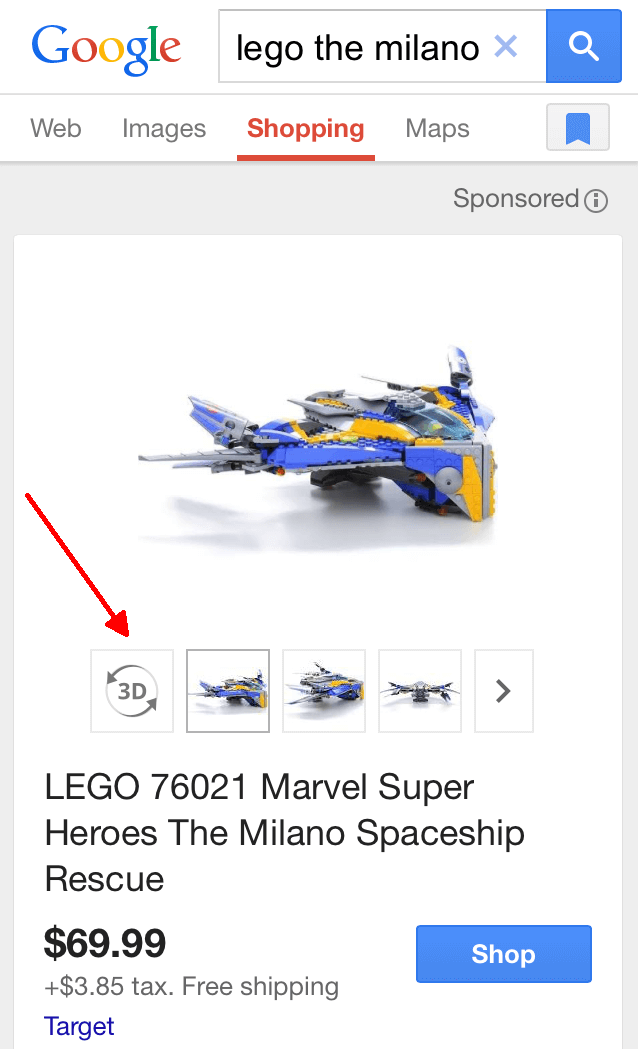
Some products, like this Lego spaceship now have 360 degree views available from Google Shopping on mobile devices.
google shopping 3D mobile view black friday
Lastly, Google is expanding Local Inventory ads to tablets. These ads are now available across all devices.
Google is clearly aiming to drive more mobile product searches straight to Google Shopping this holiday season, and beyond. With the huge growth in mobile search volume, retailers should make note of these changes to ensure their listings are prominent in Google Shopping and understand that mobile text ads for specific products are likely to see less and less action if this format succeeds.
02:22 | 0 comments | Read More

Google Settles UK “Defamation” Suit, Agreeing To Remove Malicious Links

Action is latest in larger pattern in battle for control of search index.

law-legal1-ss-1920
Google has long maintained it’s not responsible for third party content in its index. And that’s the law in the US. However increasingly in Europe authorities and individuals are seeking to make Google legally responsible for the content in its search results.
The latest example comes in the form of a legal settlement in a UK defamation action. Characterized as an “exceptional” case, Google agreed to remove malicious links that damaged the reputation of UK businessman Daniel Hegglin. The settlement terms weren’t disclosed but likely involve specific actions on Google’s part to remove the defamatory material.
Google may have been motivated to settle to avoid creating case law that would have imposed further burdens or responsibilities on the company for questionable or illegal content in its index.
Google does not appear to have been directly sued for defamation. However Hegglin sued a range of unknown others for defamation and damage to his reputation. He brought Google into the case on a related theory. The plaintiff had been labeled “a murderer, paedophile and Ku Klux Klan sympathiser by an unknown internet troll.”
The settlement was reported by the BBC. Search Engine Land columnist Chris Silver Smith was retained as an expert witness for the plaintiff in the case.
Google had been cooperating with Hegglin and his attorneys and had reportedly made “significant efforts” to remove the disputed links and material. It appears that the majority or all of the defamatory material was posted anonymously.
The case did not arise under the right-to-be-forgotten but was more straightforwardly as a reputation-defamation case.
As mentioned US law doesn’t hold search engines liable for content created by third parties that appear in search results. In the US Google will remove (and does remove) content found to be defamatory after there’s been a legal process adjudicating the question.
We’ve asked Google to comment and will postscript this post if the company offers a statement.
Stepping back this case falls into a larger pattern of legal, regulatory and political moves in Europe. These include the recently established right-to-be-forgotten, newly restrictive copyright laws, the ongoing antitrust investigation and more stringent privacy rules.
All these things combine to put more pressure Google, as a range of parties and interest groups seek to control what the company can do and show in its index and increasingly try and make it responsible for third party maliciousness.
Postscript: Google provided the following statement: “We have reached a mutually acceptable agreement.”  

02:22 | 0 comments | Read More

Google Payday Loan Algorithm 2.0 Launched: Targets “Very Spammy Queries”: Official News

Written By Unknown on Tuesday, 20 May 2014 | 20:36

Google Payday Loan Algorithm 2.0 Launched: Targets “Very Spammy Queries”: Official News

spam-viewer-featuredGoogle has confirmed they have released a new algorithm update to their Payday Loan Algorithm update over this weekend.

This algorithm specifically targets “very spammy queries” and is unrelated to the Panda or Penguin algorithms. A Google spokesperson told us:
20:36 | 0 comments | Read More

Google Begins Rolling Out Panda 4.0 Now

google-panda-xcu-600Google’s Matt Cutts announced on Twitter that they have released version 4.0 of the Google Panda algorithm.
Google’s Panda algorithm is designed to prevent sites with poor quality content from working their way into Google’s top search results.
But didn’t Google stop updating us on Panda refreshes and updates since they are monthly rolling updates? Yes, but this is a bigger update.
20:32 | 1 comments | Read More

Google and the Death of “Do No Evil” | Sitepronews.com Article

Written By Unknown on Monday, 28 October 2013 | 04:17

Google LogosAfter 16 years of helping other businesses achieve a greater prominence for their websites, the past 2 years of insanity has given me pause to contemplate the future.

Clearly, Google is intent on rendering my chosen vocation irrelevant. The previous ability to attain decent rankings has been eroded as Google eats away at the foundations of SEO and progressively eliminates legitimate opportunities to be a “tall poppy” on the www.
04:17 | 0 comments | Read More

Goodbye, Keyword Data: Google Moves Entirely to Secure Search

Written By Unknown on Thursday, 26 September 2013 | 11:32

The day many SEO professionals hoped would never come, but feared eventually would, apparently has arrived today. It appears that Google has cut off keyword data altogether.
Nearly two years after making one of the biggest changes to secure search that resulted in a steady rise in "(not provided)" data, Google has switched all searches over to encrypted searches using HTTPS. This means no more keyword data will be passed to site owners.
Encrypted Google searches don't pass the keyword data through to websites, thereby eliminating the ability to track users by their keyword searches. The biggest impact for many site owners has been not being able to segment users by keywords within their web analytics software.
11:32 | 0 comments | Read More

Google Product Listing Ads Drive CSE Channel Growth, Cannibalize Text Ad Clicks - Search Engine Land News

Written By Unknown on Monday, 16 September 2013 | 02:04

channeladvisor-logoThe August Same Store Sales report from ChannelAdvisor shows that the 7.7 percent growth from Comparison Shopping Engines was driven by the product listing ads (PLAs) that power Google Shopping. Search (traditional AdWords text ads) saw just a slight uptick in growth at 0.2% in August. Both channels grew more slowly than comScore’soverall ecommerce growth rate of 16 percent in Q2.
In a summary statement, ChannelAdvisor reports, “Google Shopping continues to show strength in this category helping offset headwinds from traditional CSEs.” While the average order value (AOV) from Google Shopping/PLA fell 14.6 percent year-over-year to $95.14 as more merchants entered the program, conversion rates actually increased 5.2 percent to 2.35 percent.
pla-trends-channel-advisor-august-2013
Source: ChannelAdvisor
Search grew just slightly throughout the summer. August’s 0.2 percent increase was down from July’s 0.6 percent growth rate. Clicks fell 3 percent year-over-year, which Channel Advisor attributes to cannibalization from PLAs. Search conversion rates were flat year-over-year, holding at 2.63 percent. However, AOV rose 8 percent and cost-per-click dropped 6 percent to $0.50 year-over-year.
While Search and CSE growth lagged behind that of the overall ecommerce market, Amazon and eBay continue to show strong SSS growth. Read more about their performance on Marketing Land: Amazon And eBay Same Store Sales Growing Faster Than Overall Ecommerce.
02:04 | 0 comments | Read More

Google Wants You To Tell It Specific Sites To Rank Better

Written By Unknown on Monday, 2 September 2013 | 05:07

Assuming that Matt Cutts’ Twitter account wasn’t hijacked, Google wants you to tell it if you know of any small sites that should be doing better in Google rankings.

Do you think Google will really listen to this feedback? Do you think many will suggest sites they’re not affiliated with? Let us know what you think in the comments.

If you’ve ever thought Google is giving too much weight to big brands, I guess this is your chance to weigh in on the better alternatives, wait, and see if your suggestion did any good.


If there's a small website that you think should be doing better in Google, tell us more here: https://docs.google.com/forms/d/1Czwk15Yc_-zcnnlvqTuspEnz2Sn3Aw2JxhkWvoVxVS4/viewform 

Cutts points to a form, which says, ‘Google would like to hear feedback about small but high-quality websites that could do better in our search results. To be clear, we’re just collecting feedback at this point; for example, don’t expect this survey to affect any site’s ranking.” Emphasis added.

You simply enter the site, and then in a box, explain to Google what makes it better. Here’s what it looks like:
Small site survey

Hope this information will help you in some way or the other.
05:07 | 0 comments | Read More

25 Percent of North American Internet Use is Drived by Google

Written By Unknown on Thursday, 25 July 2013 | 07:35

25 Percent of North American Internet Use is Drived by Google

Google truly is king of the Internet boasting 25 percent off all North American online traffic — a new Web record.
In fact, Google has become so prevalent in the online world, 62 percent of all end users and their devices exchange traffic with Gmail, Google search, YouTube and Google Maps during the course of an average day, according to analytics firm Deepfield.
Deepfield’s said Google would control an even larger share had it analyzed only computers, Smartphones and tablets. However, the company also took into account game consoles, home media appliances, and other embedded devices.
“While it is old news that Google is BIG , the sheer scale and dominance of Google in the Internet infrastructure has significant implications on network design and evolution,” said DeepField founder Craig Labovitz in a blog post. When we last published some large-scale measurements in 2010, Google represented (a now seemingly small) six percent of Internet traffic. Today, Google now accounts for nearly 25 percent of Internet traffic on average.”
google
Although Deepfield does not say what is responsible for the giant leap Google has made in the last three years, it is thought YouTube is likely the driving force behind the technology company’s rapid rise.
To put the numbers into perspective, Google serves up more data than Facebook, Instagram and Twitter combined. Only Netflix has larger bandwidth than Google and that is during the evening prime time hours and the Internet television service’s cache update periods in the early morning.
“Google’s Internet presence has come with the deployment of thousands of Google servers in Internet providers around the world,” Labovitz added. “With little press coverage or fanfare, Google has deployed (Google Global Cache) servers in the majority of U.S. Internet providers. By comparison, we observed GGC deployments mostly in Asia, Africa and Latin America when we last did a large scale study in 2010.”
Read Original Post: Click Here
07:35 | 0 comments | Read More

Google Updates Says: A multi-screen and conversational search experience

Written By Unknown on Saturday, 20 July 2013 | 10:32

Google made some big announcements at a major conference (called Google I/O) last week, with a number of futuristic tools and services, here is some info on how they are evolving search into more of what they call a ‘conversation’ where you can ask questions and be given answers verbally.
“Search has always been about giving you the best answers quickly, regardless of what device you use. At Google I/O today, we gave an update on where we are in building the search engine of the future–a search engine that can answer your questions, have a conversation with you, and even give you useful things without you ever having to ask. “
Read Original Post: Click Here
10:32 | 0 comments | Read More

As Google Moves Away From Keywords, Can You Optimize For Gist?

Written By Unknown on Monday, 15 July 2013 | 01:12

By Amit Rawat
Today, keywords still play a significant role in search habits, and in how Google and other search engines deliver search results. The trend, however, is moving further and further away from this, especially on Google’s side. Google wants to become less dependent on keywords, and gradually doing so.
When Google launched the Knowledge Graph, it was clear how proud the company’s engineers and executives are of what they have put together.
Google’s Matt Cutts proclaimed, “It’s another step away from raw keywords (without knowing what those words really mean) toward understanding things in the real-world and how they relate to each other. The knowledge graph improves our ability to understand the intent of a query so we can give better answers and search results.”

Since then, Google has made numerous enhancements to the Knowledge Graph, and has tweaked its algorithm in other ways that would seem to indicate a decreased dependence on keywords. In fact, there have probably been a number of changes related to this that we don’t even know about because Google stopped publishing their monthly lists of algorithm updates for some reason.
Then there’s search-by-voice and conversational search.
Google put out a pretty interesting Webmaster Help video this week in which Cutts discusses voice search’s impact on searcher behavior. In response to the question, “How has query syntax changed since voice search has become more popular?” Cutts talks about the trends that Google is seeing.

“It’s definitely the case that if you have something coming in via voice, people are more likely to use natural language,” says Cutts. “They’re less likely to use like search operators and keywords and that sort of thing. And that’s a general trend that we see. Google wants to do better at conversational search, and just giving your answers directly if you’re asking in some sort of a conversational mode.”
While search-by-voice is certainly a growing trend on mobile, Google, as you may know, recently launched its conversational search feature for the desktop, and improvements to that shouldn’t be far off.
Cutts continues, “At some point, we probably have to change our mental viewpoint a little bit, because normally if you add words onto your query, you’re doing an ‘and’ between each of those words, and so as you do more and more words, you get fewer and fewer results, because fewer and fewer documents match those words. What you would probably want if you have spoken word queries is the more that you talk, the more results you get because we know more about it, and so you definitely have to change your viewpoint from ‘it’s an and of every single word’ to trying to extract the gist – you know, just summarize what they’re looking for, and that matching that overall idea.”
Good luck trying to optimize for gist.
“If you take it to a limit, you can imagine trying to do a query to Google using an entire document or you know, a thousand words or something like that,” Cutts adds. “And rather than match only the documents that had all thousand of those words, ideally, you’d say, ‘Okay, what is the person looking for? Maybe they’re telling you an awful lot about this topic, but try to distill down what the important parts are, and search for that.’ And so it’s definitely the case that query syntax has changed. I think it will continue to change. You know, we allow people to query by images. You can search for related images by dragging and dropping a picture on Google Image Search. So people want to be able to search in all kinds of ways. They don’t want to think about keywords if they can avoid it, and I think over time, we’ll get better and better at understanding that user’s intent whenever we’re trying to match that up and find the best set of information or answers or documents – whatever it is the user’s looking for.”
These days, Google is pretty hit and miss on the relevancy front when it comes to voice search, but I have no doubt that it will continue to improve rapidly. It’s already gotten significantly better than it was in earlier days.
Read Original Post: Click here
01:12 | 0 comments | Read More

Google Brings Carousel to Desktop for U.S. Users - SiteProNews Update

Written By Unknown on Thursday, 20 June 2013 | 04:38


Featured Article PictureBy Amit Rawat
Google search carousel is now available to English-speaking desktop users — but only in the U.S. The search engine company first introduced its carousel widget — which “allows people to take products for a spin” — for tablets last December. With carousel, a Google search for restaurants, bars or other local places brings local results to the top of the page in a colorful display of images and information. “Give it a go—type or say ‘mexican restaurants,’ or try any similar search for restaurants, bars or hotels,” the company said in a Google+ post. “Click on one of the places in the carousel to get more details on it, including its overall review-based score, address and photos. If you want to see more places, click the arrow at the right of the carousel. And you can zoom in on the map that appears below the carousel to restrict your search to only places in a specific area.”

For Original Post: Click Here
04:38 | 0 comments | Read More

Will Google Hang Up on Voice? are you Sure About it?

Written By Unknown on Wednesday, 17 April 2013 | 23:26


Millions of Android users began salivating late Monday when a Google Voice update surfaced. What could it be? The long-sought MMS feature that power users have craved since Mountain View purchased Grand Central in 2007? An update to the pre-historic user interface? International texting? Maybe it would be a way to integrate Google Voice into the main Android messaging client, a feature currently only offered on Sprint’s devices. None of the above.

Like many updates before, the changelog was a downer, described simply as “Improved the reliability of SMS delivery.”

At least Google is paying some attention to its long-neglected internet phone service. It needs to; Google Voice is being overtaken almost daily by Android and iOS chat applications that offer nearly all the features Google Voice lacks. But whether Google Voice will continue, or remain a standalone app as we know it, is uncertain. Google pulled the plug on its popular Reader RSS reading service last month, so anything is possible.

For its 3.5 million daily users Google Voice is a Big Deal. Many have literally become associated with their 10-digit Google Voice numbers and addicted to the service’s once cutting-edge features.

Those cutting-edge features aren’t so novel now. The ability to talk and text from the same phone number on multiple devices seems so yesterday. Even Verizon offers computer and tablet texting, in both the SMS and MMS flavors.

That leaves Google Voice users in a love-hate relationship, always wondering when they should jump ship and call off the love affair — all of which is clearly evident on Google Groups messaging boards: “MMS…. MMMS….MMS….Come on already!” posted one frustrated Google Voice fan.
---------------------------------------------------------------------------------------------------------------------
Or, consider this Tuesday posting:

I wish Google would stop teasing us with Voice and just shut it down (instead of Reader which actually works). Google Voice has been problematic ever since their stupid push to shove Plus and Hangouts down our throats. I can’t get Voice to interact with Google Talk so I can use my PC and headphones to make and receive calls. They just haven’t worked in years, and it requires a LOT of effort to get any kind of functionality. And now that I’ve got a new Windows 8 computer, I can’t get the extension to call me whatsoever. I’m really starting to despise everything Google does. Do us a favor Google, and just END Chat, Talk, and Voice, and then go try to stand on your own with the stupid Plus and Hangouts which are obviously your beloved love child. Reader was awesome, PLUS SUCKS!
---------------------------------------------------------------------------------------------------------------------
What we do know about Google Voice is that, in 2011, Mountain View integrated the entire operations into its real-time communications team. Headed by Vic Gundotra, that’s where the company houses its social-networking site Google+, Hangouts, Chat, and Talk.

These services all contain often-competing and disjointed messaging platforms that are likely to merge soon under a new product with a nickname of Babel. If and how Google Voice gets baked into that cake mix is unclear. Google refuses to even acknowledge Babel despite code of its existence popping up in a myriad Google products.

“As a company, we’re very invested in real-time communications,” spokeswoman Iska Hain said in a recent interview. “Google Voice is obviously a prominent part of our communications team. We don’t have anything to announce now. We’re always looking for ways to innovate and provide the best experience.”

Regarding Google Voice, Hain added: “We’re not going to leave those users high and dry. We have to think about how to make it better.”

It’s been more than five years since Google acquired Grand Central to create Google Voice,  and yet the service hasn’t really gotten much better.

The last time the Google Voice blog was updated was days before Christmas, when the service offered free calling from Santa Claus — a magnetic pole away from what the service’s users were really craving. The most recent substantial announcement on the blog was in March 2012, when voicemail integration was declared for the Ice Cream Sandwich version of Android.

Users aren’t giving up hope. Consider an Android Police teardown of the updated Google Voice application. It reveals what the Android fanboy blog describes as “an eyebrow-raising tidbit.” Android Police’s Ron Amadeo discovered that the Google Voice app’s new innards allow for the importation of Google Voice settings into other apps, meaning the service is ripe to be incorporated into another service such as Babel.

Many expect “Babel” — or whatever it’s going to be called — to be announced at Google’s I/O conference next month.

When pressed, Google’s Hain kept mum:

“We don’t have anything specific to share right now for future products in this space.”
23:26 | 0 comments | Read More

Google: PageRank Dilution Through A 301 Redirect Is A Myth

Written By Unknown on Tuesday, 26 February 2013 | 09:48

Just under three years ago, we reported that 301 redirects don’t pass full PageRank and that you should try to link through a normal link versus using 301 redirects.

The truth is, a 301 redirect and a link pass the same amount of PageRank. There is no more dilution of PageRank with a 301 redirect when compared to using a normal link.

Matt Cutts squashed this myth that I believe many SEOs thought to be true, today in a video:


Here Matt Cutts says:

The amount of Page Rank that dissipates through a 301 is currently identical to the amount of PageRank that dissipates through a link.

So the myth that you should not use 301 redirects because it will dissipate more PageRank than using a normal link is not valid.

Posted by: Amit Rawat on 26th Feb'2013
09:48 | 0 comments | Read More

Asus Qube Google's Latest TV Device

Written By Unknown on Tuesday, 5 February 2013 | 01:49


Posted by: Amit Rawat on 5th Feb'2013
01:49 | 0 comments | Read More

Can Adding Your Postcode Help SEO?

Written By Unknown on Wednesday, 30 January 2013 | 22:06


There are popular terms of an area that a person usually pair with the postcode when searching in Google. Being a website owner I make sure that for the every offer I rolled out will have some page that targets zip code searchers in a helpful way as a part of my local search engine optimization strategies, provided I have noticed visitors coming to my website using area code. In my experience, it will be fair to say that no one is searching by postal code. It usually depends on the geographic area involved, but zip code searches are very few and nobody searches with it.

22:06 | 0 comments | Read More